

Stainless Steel Hex Socket Cap Screw Distributor for Reliable Corrosion-Resistant Fastening Solutions
2026-10-01
If you've ever dealt with fasteners in damp, salty, or chemical-heavy environments, you know the frustration of rust and premature failure. That's where Wanluo steps in as a specialist distributor of stainless steel hex socket cap screws. These aren't just ordinary bolts—they're engineered to hold strong where corrosion would quickly eat away lesser metals. But with so many grades and finishes on the market, how do you know which one will actually stand the test of time? Read on to discover what makes Wanluo's fastening solutions the reliable choice for demanding applications.
Alloy Selection Beyond the 18-8 Default
The familiar 18-8 grades (304/304L) show up everywhere because they handle mild atmospheric exposure and general food contact without complaining. But once chlorides, high temperatures, or mechanical stress enter the picture, that default choice quietly starts to underperform. Pitting and crevice corrosion can appear long before visible rust, especially in coastal or de-icing salt environments. That's when moving beyond the default becomes more than a metallurgical footnote.
A small step up to 316/316L adds molybdenum, which buys meaningful resistance to chloride attack. For many architectural and marine applications, that's enough, but watch for hidden costs: welding 316 without proper filler or shielding can knock its corrosion resistance back to 304 levels. When temperatures climb or chlorides concentrate, duplex grades like 2205 offer roughly twice the yield strength of 304 while keeping chloride tolerance high, often at a lower weight and total installed cost once you factor in thinner sections.
There is no universal 'better' alloy, only a better match for specific conditions. Ferritic grades like 439 or 444 handle oxidation and stress corrosion cracking where austenitics struggle, while superaustenitic or nickel alloys become necessary in hot acid or bleach-heavy environments. Rather than reaching for a higher number on the datasheet, it pays to define temperature range, chemical exposure, and mechanical loads first, then let those realities narrow the alloy list.
Hex Drive Geometry That Prevents Cam-Out Before It Starts
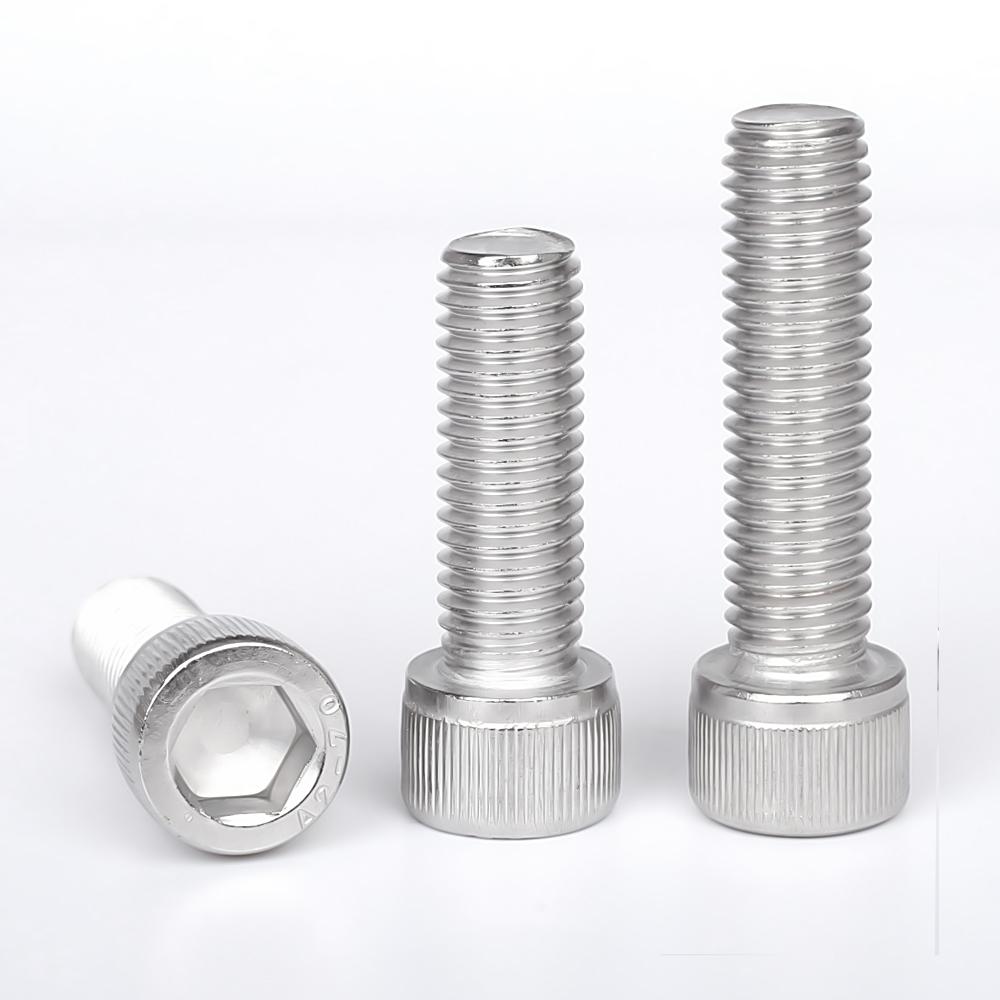
Most hex recesses rely on straight-walled flats that only engage properly when the driver is perfectly aligned. The moment torque loads shift off-axis, contact concentrates near the upper edge of the recess. That tiny line of pressure creates an upward force vector long before the joint is tight, and the driver starts climbing out.
A different geometry moves the load deeper and keeps it there. By lengthening the usable flat, adding a very slight taper only at the entry lead-in, and holding the drive faces parallel through the full engagement depth, the system eliminates the top-edge pivot point that normally triggers cam-out. The driver bottoms against a shaped seat that removes axial play, so the hex flats stay in full, even contact from the first turn.
The result is not simply a snugger fit. It changes the failure sequence. Instead of a vertical slip that chews out the recess, the geometry directs torque into the fastener axis. Once the driver is seated past the lead-in, there is no ramp or radius left to generate a lift component, which is why it stops cam-out before friction has to resist it.
What Thread Tolerance Actually Means in Salt Spray
Thread tolerance often gets treated as a simple fit-and-finish spec, but in salt spray testing it becomes a hidden variable that decides whether corrosion starts early or stays controlled. A slightly looser fit may seem harmless on the bench, yet in a salt fog chamber the extra clearance acts like a capillary network, drawing salt-laden moisture deep into the engaged threads where rinsing and drying never fully reach.
Coating thickness also plays a direct role. Hot-dip galvanizing or heavy zinc flake coatings can add several microns to the thread flanks. When tolerance bands are not adjusted for that buildup, assembly can shear the coating right off the crests and flanks, leaving bare steel that fails salt spray within hours—not because the coating was poor, but because the thread geometry fought against it. This is why real-world test failures often show red rust starting at the first engaged thread, not on flat surfaces.
In practice, thread tolerance in salt spray means you’re managing three things at once: how much clearance exists after coating, how well the coating survives installation, and whether the engaged threads leave any pockets for salt solution to sit. A tolerance that works for a dry indoor assembly can become a corrosion trap in a marine environment. Testing threaded parts as standalone pieces often misses this, because the failure only appears after you torque them together and let the salt fog do its work in the microscopic gaps.
Stock Depths That Match Production, Not Just Catalogs
Most stocking plans start with a catalog and hope reality follows. That leaves shelves crowded with low-turn parts while the items actually feeding daily production run short. Matching stock depth to real pull signals changes the equation: instead of one-size coverage across every SKU, the fast movers get layered buffer quantities tied to recent consumption and supplier lead time variability, while slow movers sit at deliberate one- or two-piece minimums.
The difference shows up quickly on the floor. A line stoppage waiting on a high-usage fastener is measured in minutes, not in how many catalog pages list that part. Rebalancing depth around actual issue frequency and open work order demand trims excess inventory without cutting into availability. It also exposes where blanket catalog breadth was masking genuine demand spikes that deserve deeper, temporary stock.
Buyers can stop chasing reorder points copied from a distributor's generic recommendation. Instead, depth becomes a rolling conversation between production schedules, supplier performance, and historical usage variance. The result is a stockroom that feels lean but not fragile: enough of the right items to keep machines running, and far less money parked in items that only look important on a spreadsheet.
Traceability Paperwork That Survives Audits Without Panic
Most audit panic starts with documents that nobody checked until the auditor asked for them. The fix is less about neatness and more about rhythm: log batch numbers on the same day you receive raw materials, attach supplier certificates to the purchase order instead of a separate folder, and keep a one-page summary for each production run that links ingredients, equipment, and finished goods. When the chain is updated in small steps, the paperwork stops being a reconstruction project and becomes a byproduct of daily work.
Paper trails that hold up under pressure usually have one thing in common: they show a sequence someone can follow without calling three departments. Use a simple numbering system that ties incoming lots to outgoing shipments, and mark any deviation or correction directly on the record with a date and initials, rather than rewriting clean copies later. Auditors tend to trust slightly messy but honest logs far more than pristine documents that look assembled the night before.
Before an audit, resist the urge to reorganize everything. Instead, walk the floor with the actual records and check whether a person who was not there that day could trace a single ingredient from receipt to final product in under ten minutes. If a gap appears, fill it with a short note explaining what happened, who approved it, and when. That kind of plain, consistent documentation removes the fear factor because the story is already there, waiting to be read.
Passivation and Finish Options That Extend Service Life
Stainless steel components rely on a microscopically thin chromium oxide layer for corrosion resistance, yet this protective film is easily compromised by free iron, machining debris, or embedded contaminants from tooling. Passivation restores the alloy's inherent nobility by dissolving surface iron and triggering a uniform oxide regeneration, effectively halting the initiation of pitting and crevice corrosion. Without this step, even high-grade 316 parts can develop rust staining in marine or chloride-heavy environments within months.
Beyond chemical passivation, specialized finishes such as electropolishing, mechanical mirror polishing, and black oxide conversion each alter the surface profile in ways that directly influence fatigue life and cleanability. Electropolishing removes a controlled layer of material, smoothing microscopic peaks that act as stress risers and bacterial harborage points, while also enriching the surface with chromium for superior passivity. For high-cycle or hygienic applications, pairing electropolishing with a final citric or nitric passivation step creates a duplex treatment that outperforms either method alone.
Selecting the right finish requires balancing operational conditions, part geometry, and cost. In coastal installations or food-processing lines, a 20-30 microinch Ra electropolished surface followed by passivation yields decades of service with minimal maintenance. For less aggressive inland environments, a simple nitric passivation after machining may suffice, while components exposed to repeated thermal cycling benefit from a mechanical polish that reduces notch sensitivity. Documenting each finish's impact on surface roughness, residual stress, and passive layer integrity ensures the chosen method aligns with the actual failure modes the part will face.
FAQ
The chromium in the alloy forms a passive oxide layer that heals itself when scratched, so the fastener keeps resisting rust even after minor surface damage. For brackish or saltwater exposure, 316 stainless usually outperforms 304 because of the added molybdenum.
Start with 304 for general indoor or mild outdoor use where occasional moisture is the main concern. Move up to 316 when the screws will face constant humidity, salt spray, or chemical cleaners—molybdenum makes the difference in pitting resistance.
316 stainless hex socket cap screws often work fine in marine settings without extra plating, but they are not completely immune to crevice corrosion. Rinsing exposed fasteners with fresh water and avoiding stagnant salt deposits will extend their life more than any coating would.
Look for traceability of the alloy, not just a low price. A dependable distributor should provide mill certifications or at least confirm the grade, and should stock both coarse and fine thread options so you are not forced to compromise on thread fit.
Yes, because the recessed hex engages a wrench or bit on six sides instead of relying on downward pressure. That means you can apply more torque with less risk of cam-out, and the cylindrical head profile lets you place fasteners closer together or inside recessed holes.
They can gall if you rush installation, especially with power tools. Using a quality hex bit, slowing down, and applying a nickel-based anti-seize on threads prevents most galling and gives you a tighter, more reliable clamp load.
One common issue is galvanic corrosion when stainless touches a more reactive metal like aluminum or zinc-coated steel in the presence of an electrolyte. Use insulating washers or match the fastener to the base material to avoid that trouble.
Most reputable distributors stock both fine and coarse threads. Coarse threads are more forgiving in softer materials and assemble faster, while fine threads offer a slight edge in vibration resistance and adjustment precision.
Conclusion
The default 18-8 chemistry works for many indoor jobs, but a distributor who only stocks that one alloy quietly limits your options. We keep 316, 410, and duplex grades on the shelf so you can match the fastener to actual exposure, whether it's chlorides, mild acids, or temperature swings. The hex socket itself is re-engineered with a deeper, more precise broach that lets the key seat fully before torque is applied, which kills the wobble that leads to cam-out and rounded recesses. On top of that, thread tolerance is not just a shop-floor number. In salt spray testing, a tighter class 2A/2B fit holds the protective oxide layer longer because there's less crevice for moisture to creep into, and that small difference shows up as fewer red rust streaks after 500 hours.
Real production schedules don't care what a catalog says is "available." We carry deep stock in the diameters and lengths that actually move on assembly lines, so a missing box of M8 x 25 doesn't stall a shift. Every lot arrives with full traceability paperwork, heat numbers, and test reports organized the way an auditor wants to see them, not the way a warehouse sometimes keeps them. And because corrosion resistance is also a surface story, passivation and optional finishes like black oxide or a thin dry-film lube are applied to the exact spec you call out, extending service life without changing the base alloy. The result is a supply partner that handles the unglamorous details so the joint stays clean, tight, and easy to defend on paper.
Contact Us
Contact Person: Shane
Email: [email protected]
Tel/WhatsApp: 8613357785029
Website: https://www.wanluohardware.com