

Powder Valve Factory: Precision Manufacturing for Bulk Solids Handling
2026-10-15
When powders flow, every valve matters. In bulk solids handling, a single valve failure can halt production, compromise safety, or contaminate an entire batch. That’s why AVM doesn’t just manufacture powder valves—we engineer precision barriers that keep your process moving. From abrasive minerals to delicate food ingredients, our factory blends tight tolerances with robust design, turning a simple component into a critical control point. Curious how the right valve can transform your bulk handling line? Let’s open the discussion.
Tolerances That Keep Fine Powders Flowing Without Bridging
Fine powder bridging is rarely caused by a single factor; it emerges from the interaction of hopper geometry, wall surface finish, and outlet dimensions. For particles below 100 microns, the hopper half-angle must stay within a band of 65° to 70°. Even a few degrees outside this range creates a stable arch above the outlet that resists gravitational pull. The ratio of outlet diameter to particle size also needs a minimum threshold—without it, powder locks in place even when the angle appears correct.
Surface roughness tolerances are tighter than most operators assume. Mirror-polished walls below Ra 0.2 µm reduce mechanical interlocking but can introduce another problem: extremely fine particles adhere through van der Waals forces, forming a rolling powder film. That film thickens over time and effectively narrows the outlet. A finish between Ra 0.3 and 0.5 µm with a subtle directional texture suppresses both bridging and film buildup.
Dynamic assist devices also demand carefully defined clearances. A rotating anti-bridging arm typically runs 2–5 mm from the hopper wall. This gap prevents metal contact, sparks, and wear debris, yet keeps the arm close enough to scrape compacted powder near the wall. If the gap grows wider, stable powder bridges survive in the dead zone; if it shrinks, thermal expansion or slight particle size swings cause jamming.
How Raw Bar Stock Becomes a Finished Powder Valve
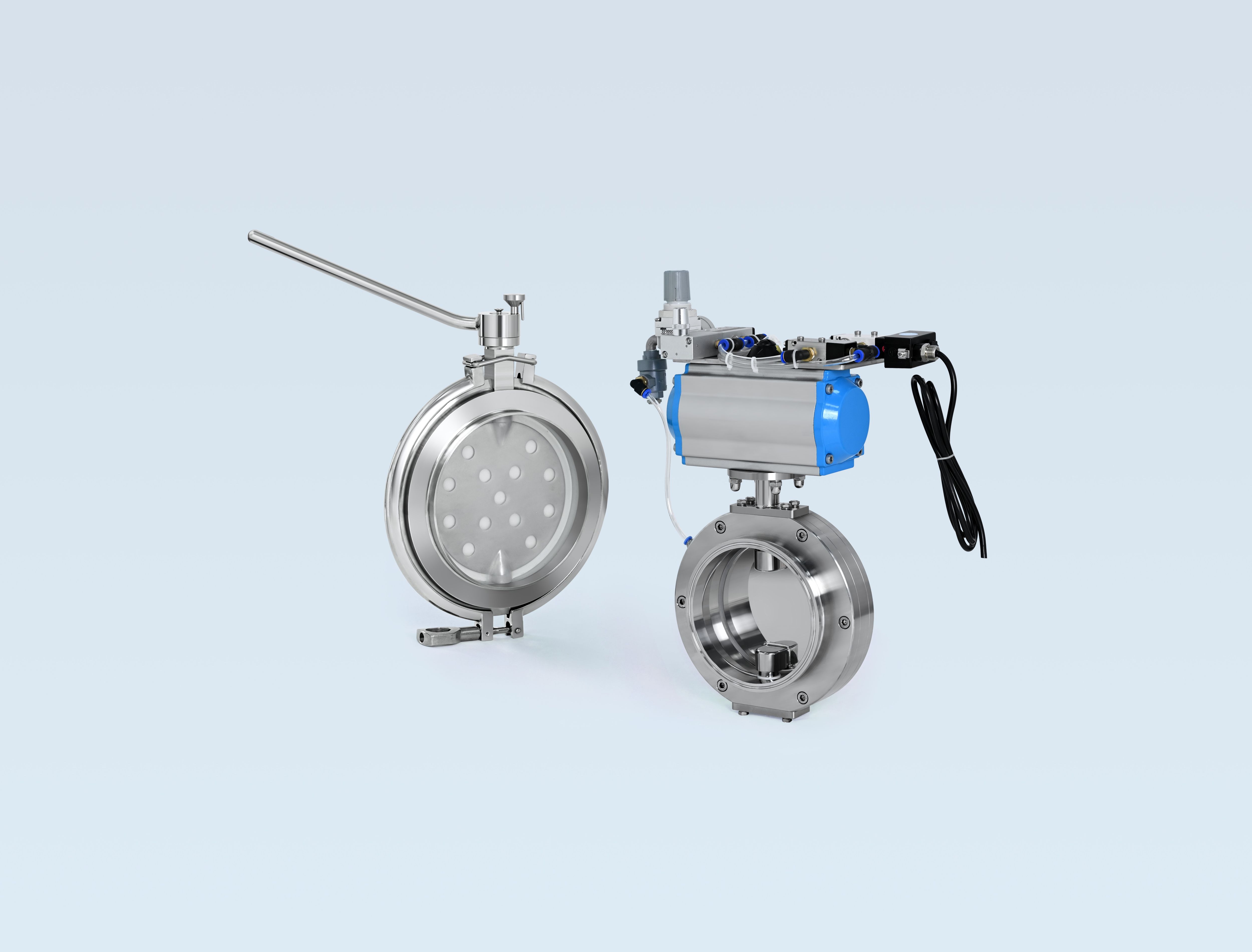
The journey starts with solid round bar stock, typically 316 stainless steel or a hardened alloy, depending on the abrasive nature of the powder being handled. The bar is cut into billets slightly longer than the finished valve body, then faced and center-drilled on a lathe. A CNC turning center bores the internal cavity, cuts the inlet and outlet ports, and machines the sealing surfaces to a tolerance within a few microns. No off-the-shelf casting here—every pass removes material from the same homogeneous billet, which means the final body has no porosity or weak spots that could trap powder or crack under pressure.
Once the body and rotor are machined, the real fitting begins. The rotor is ground to match the bore with a controlled clearance, often between 0.05 and 0.15 mm, so powders flow smoothly but don't leak back. End plates and shaft seals are press-fitted or bolted on, then the whole assembly goes through a series of air-leak tests and a dry-run cycle with an inert powder to check for binding or dead zones. Only after passing those checks does the valve get cleaned, serialized, and packed—ready to slot into a production line where raw powder meets precise metering.
Wear Resistant Materials and Coatings for Abrasive Bulk Solids
Handling abrasive bulk solids—like silica sand, alumina, or crushed ores—shortens the life of chutes, hoppers, and conveyor liners. The most direct fix is to select base materials with high hardness and toughness. Quenched and tempered alloy steels, cast white irons with chromium carbides, and alumina or silicon carbide ceramics each balance wear resistance with the ability to survive impact. For thick sections that must absorb heavy blows, work-hardening manganese steels remain a practical choice because their surface hardness increases under repeated impact.
When replacing an entire component is impractical, surface coatings extend service life. Tungsten carbide and chromium carbide overlays applied by welding are common on screw conveyors and bucket edges. Thermal spray coatings, including high-velocity oxy-fuel (HVOF) tungsten carbide and plasma-sprayed ceramics, create thin, tightly bonded layers that resist sliding abrasion. Elastomer coatings such as rubber or polyurethane can outperform hard materials in wet or high-impact conditions because they deflect particles rather than absorb their energy.
Choosing the right material or coating depends on particle size, velocity, moisture, and angle of attack. A ceramic tile lining may crack under large lump impact, while a soft polyurethane liner may wash out under fine, dry, high-speed abrasion. Whenever possible, test coupons in the actual flow stream and monitor wear patterns before committing to a full retrofit.
Pressure Testing and Cycle Testing Before Every Shipment
Every valve gets pulled from the batch and run through pressure testing at 1.5 times its rated working pressure before it goes into a box. We do this on a dedicated test bench with calibrated gauges, and the results are logged against the serial number. Any unit that shows even a small drop gets pulled aside, stripped, and rechecked rather than shipped with a hope and a prayer.
Cycle testing happens right after, usually a few hundred open-close strokes under load to catch seat wear, stem packing leaks, or any binding that only shows up after repeated use. It is not a quick pass-fail glance; we watch for changes in torque and look for tiny leaks at the stem after the valve has been worked. Only the ones that hold steady through the full sequence make it to packing.
Inlet Outlet and Actuation Choices That Fit Existing Feeders
Retrofitting a feeder usually stalls when the new unit won't line up with existing chutes, hoppers, or downstream tooling. Inlet and outlet geometry matters more than horsepower here. Look for inlet flanges that can be clocked to match your current bolt circle, or use a short transition spool that absorbs slight offset without a custom weldment. On the outlet side, a replaceable wear liner and a discharge lip that sits at the same height as the old feeder keep material flow unchanged.
Actuation should follow what the plant already powers and controls. If the old feeder used 24 VDC solenoid valves, staying with the same coil voltage avoids pulling new cable or swapping I/O cards. Stroke length and cycle rate can be tuned with a simple flow control, but the mounting pattern of the actuator needs to drop into the existing bracket. Air cylinders with a rear clevis or nose mount often give the most flexibility when the original bracket stays untouched.
Choosing modular inlet, outlet, and drive options instead of a one-size package means the replacement can be staged during a short shutdown. Existing wiring, guard interlocks, and even the PLC logic remain useful because the new parts fall within the same signal and pressure ranges. That kind of fit reduces the temptation to re-engineer surrounding equipment just to accommodate a feeder.
Direct Engineering Support for Retrofits and New Bulk Handling Lines
When existing equipment starts showing its age, a generic replacement often creates more problems than it solves. That’s why support here starts with a physical walkdown of the line—measuring clearances, mapping transfer points, and reviewing current dust and spillage patterns before any design work begins. For retrofits, the focus stays on keeping your structure, drives, and take-ups where possible, and targeting only the components that actually limit throughput or cause recurring cleanup.
For new bulk handling lines, the same engineers handle layout, chute geometry, belt tensions, and load zone details in one pass instead of handing the project between departments. You get drawings that reflect the real material characteristics—angle of repose, moisture content, abrasive wear—not just standard catalog selections. Support continues through fabrication review and commissioning, including on-site adjustments for belt tracking, skirt seal gaps, and transfer point alignment until the line runs steadily at the planned rate.
FAQ
The lineup includes slide gate valves, butterfly valves, rotary airlocks, and pinch valves. Each type is built to manage different flow behaviors, from free-flowing granules to cohesive or abrasive powders.
Material selection plays a big role—stainless steel, hardened alloys, and polymer liners are chosen based on abrasiveness, temperature, and chemical exposure. Internal clearances and seal geometry are also fine-tuned to reduce jamming and leakage.
Yes, custom engineering is common. The team reviews particle size distribution, moisture content, discharge rate, and pressure differentials before proposing flange dimensions, actuator type, and inlet/outlet configuration.
Food and beverage, pharmaceuticals, chemicals, plastics compounding, minerals processing, and cement production all rely on them for controlled feeding, isolation, and discharge of dry solids.
It means holding tight tolerances on mating surfaces, shaft alignment, and seal compression so that valves open and close smoothly, even after thousands of cycles with fine dust present.
Each unit undergoes leak testing, cycle testing, and sometimes material-handling trials with representative powders. Documentation of test results accompanies the shipment for traceability.
Beyond the product, the factory provides installation guidance, maintenance schedules, spare parts kits, and technical support for troubleshooting flow issues or wear.
Conclusion
Powder valves built in this factory are not just machined parts; they are engineered to keep fine bulk solids moving without the interruptions caused by bridging or ratholing. The tolerances are held tight enough that even sub-micron powders can slide through the body without packing into dead zones, while the bore and disc profiles are shaped to shear rather than compact the material. Raw bar stock enters the shop as certified stainless or carbon steel and leaves as a finished valve only after turning, milling, honing, and lapping operations bring every sealing face to a repeatable surface finish. For abrasive duties, hardened alloys, tungsten carbide coatings, or ceramic inserts are applied where the flow stream would otherwise cut a groove through a softer seat or blade. These material choices come from decades of watching which bulk solids destroy ordinary valves and which combinations survive year after year.
Before any shipment is released, every valve is pressure tested with air or water and cycled through thousands of open-close strokes to expose any leak path or actuator weakness that might appear only after installation. Inlet and outlet patterns are machined to match existing feeders, hoppers, and conveying lines—whether that means square flanges, round spools, or custom drillings—so a retrofit does not force a whole line to be redesigned. Actuation is likewise matched to the plant: manual handwheels, pneumatic cylinders, electric motors, or chainwheel operators can be fitted without changing the valve's internal geometry. When a new bulk handling line is being planned or an old one is being upgraded, the engineering team works directly with plant staff to select the right bore size, pressure class, and sealing style, then documents every dimension so the next replacement drops in without field modification.
Contact Us
Contact Person: Ananda
Email: [email protected]
Tel/WhatsApp: 8619016718200
Website: https://www.wzaomi.com